Posts Tagged ‘Business Analysis’

Being Agile when Designing and Playing Agile Games

Friday, July 30th, 2010

By Mary Gorman

In my Stickyminds.com column “Playing at Work: Agile Games Deliver Value” I share game ideas and experiences – the benefits games can provide, selecting an appropriate game, facilitating a game, and designing a winning game.

Designing and Facilitating Agile Games

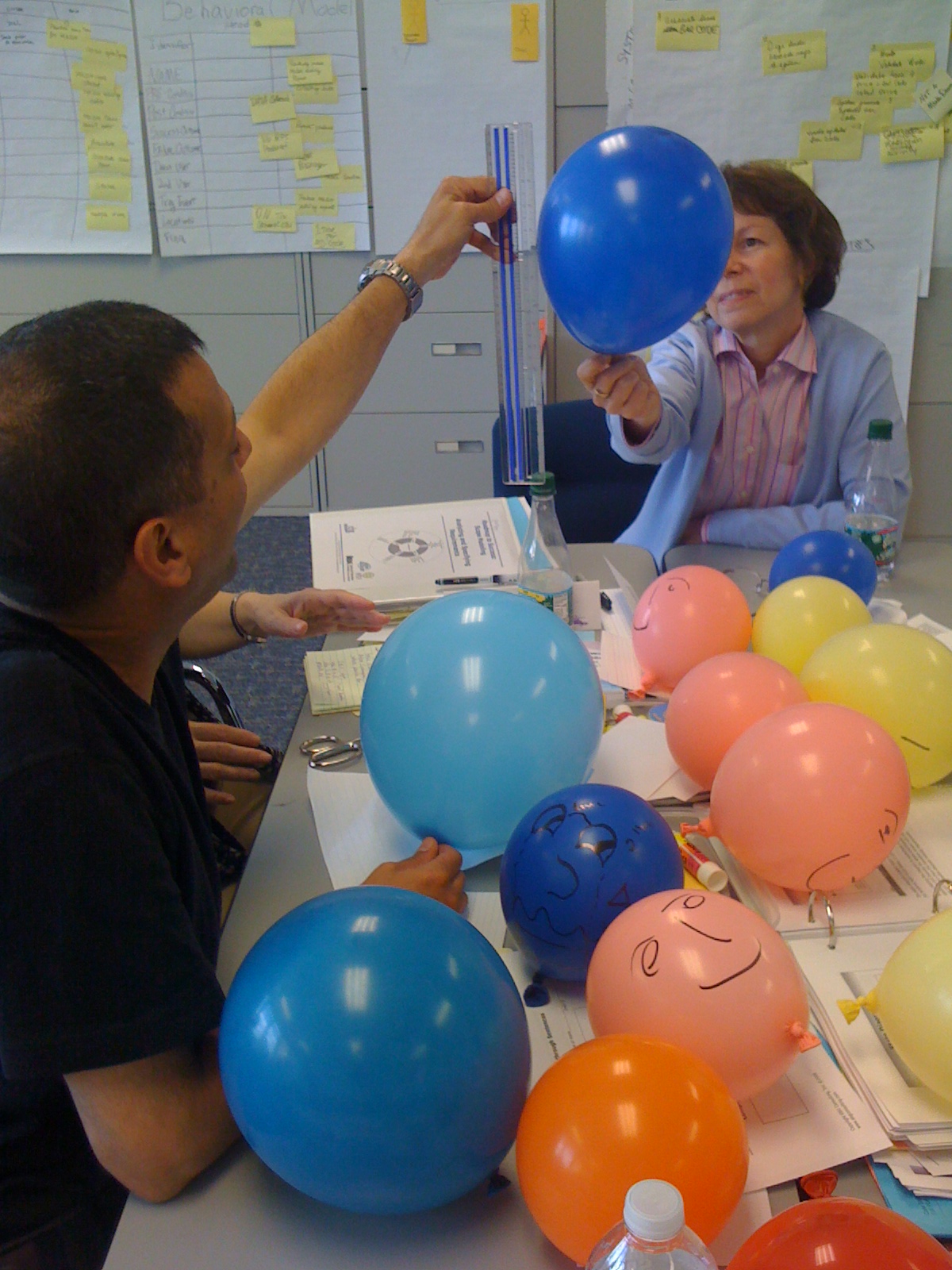
When writing the column I got to thinking how agile principles could provide a basis for good game design and facilitation. I reflected on a recent experience I had at Deep Agile 2010: Empowering Teams with Agile Games. Working in a small group we created a new game, tested it, and retrospected both the game and our design process in less than half a day. We consciously (and some times unconsciously!) were being agile! (To see and learn more about our game, read Michael Sahota’s summary at The Backlog Is in the Eye of the Beholder.)

Games and The Agile Manifesto

To clearly communicate the agile-ness of our work and what we learned I did a quick mapping to the Manifesto for Agile Software Development. Continue reading

    Share/Bookmark

Lessons on Collaboration: Retrospective on Delivering the IIBA BABOK, Part 1

Wednesday, March 17th, 2010

What are good practices for delivering a complex product for a broad global customer with a group of volunteers scattered all over the world?

This is a real-world question for me right now: I’ve volunteered to participate on the Agile-BABOK® (Business Analysis Body of Knowledge) addendum effort. Like the BABOK itself, this addendum can impact the practices of a broad worldwide community of professionals.

Learn From Those Who Have Been There Before

Two groups have tackled the problem of using volunteers to deliver an industry standard, so I figured we should “learn before we burn”. One group is the PMI Agile Community of Practice group, and the other is the BABOK Body of Knowledge Committee.

Ideally, learning what worked for these groups, along with their suggestions for what they would do differently were they to do this again, could help the Agile-BABOK addendum effort to start smart: leverage what they’ve found works, avoid or mitigate what didn’t work, and adjust their practices based on their experience. Continue reading | 1 Comment

    Share/Bookmark

How Agile is Influencing the Traditional Business Analyst Role Part 2

Tuesday, March 2nd, 2010

In my earlier post, How Agile is Influencing the Traditional Business Analyst Role: Part 1, I provided the first set of answers to questions posed to me by a Modern Analyst writer preparing a article on how Agile is impacting the traditional business analyst (BA) role.

Here I continue with the questions and my responses.

What are your thoughts? Do you agree?

In Scrum, do you think a Business Analyst could (or should) be the Product Owner, ScrumMaster, or a regular team member?

Yes, maybe, yes, maybe, yes maybe.

In Scrum, we have the product owner “role.” The PO is perhaps the most important (and burdened) role. The PO must conduct a mix of strategic and tactical activities.

Strategic activities are business or market facing—for example, analyzing the market and business case, defining the product vision and roadmap, developing requirements, adjusting the product backlog, and determining delivery plans.

Tactical activities are delivery team facing—for example, specifying the items to be delivered in each iteration, determining acceptance criteria for them, analyzing dependencies between items, and making tough decisions about what will be built to satisfy a given business need, technical risk, and requirements dependencies. Some great business analysts I’ve worked with pitch in to build and run user acceptance tests.

All this takes a lot of knowledge and many skills, and it consumes a lot of time.

On top of that, to fulfill both strategic and tactical activities on an agile project, the business customer needs experience in product development, along with deep domain and product knowledge.

I’ve coached (and trained) teams working on large, complex products, and I’ve seldom known a single business customer who can do these strategic and tactical activities.

That’s why many organizations turn to talented business analysts for help with the day-to-day, tactical decision making on their agile projects. In other cases, someone who was formerly a traditional business analyst will work out the backlog items, suggest the priorities, and then obtain validation from the business PO. Continue reading | 1 Comment

    Share/Bookmark